|
CHINA ROBOTICS
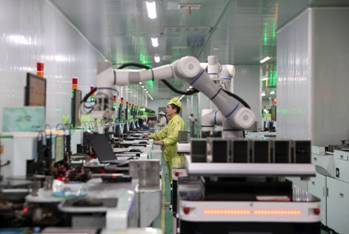
Robotics is the
interdisciplinary study and application of engineering, computer
science, and technology to design, build, and operate robots that mimic
or replace human actions. It integrates sensors for environmental
perception, actuators for physical movement, and AI for decision-making
to automate tasks across industries like manufacturing, healthcare, and
exploration.
Key
Aspects of Robotics:
-
Definition:
An intersection of mechanical engineering, electrical engineering,
and computer science.
-
Components:
Robots typically consist of sensors (to perceive the world),
actuators (motors/systems for movement), and controllers [the
"brain" or computer]
-
Purpose:
To improve efficiency, safety, and productivity by automating
repetitive or dangerous tasks.
-
Applications:
Industrial automation (manufacturing), service robots
[cleaning/delivery], healthcare [robotic surgery], and,
space/deep-sea exploration.
-
Integration with
AI: Modern robotics heavily utilizes
artificial intelligence, allowing machines to learn from their
environment and operate with increased autonomy.
Robotics is advancing
toward creating machines that interact more naturally with humans and
operate in complex, unpredictable environments
CURRENT STATUS OF ROBOTIC
TECHNOLOGY IN CHINA
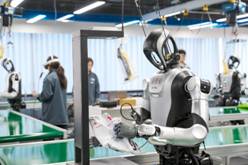 
As of early 2026, China
is the world’s dominant force in robotics, leading in both industrial
automation and the rapid, large-scale commercialization of humanoid
robots. Backed by extensive state funding and a mature and complete
supply chain, China accounts for over half of global industrial robot
installations, with over 2 million units operating in factories.
Key Aspects of China's
Robotics Status in 2026:
-
Industrial
Dominance: China is the world's
largest market for industrial robots, with 295,000 new units
installed in 2024, surpassing the rest of the world combined. Key
sectors driving this include electric vehicles [EVs] and
electronics.
-
Humanoid Robotics Boom:
2025 was considered the first year of mass production for Chinese
humanoid robots, with over 140 manufacturers releasing 330+ models.
Companies like
Unitree
[5,500+ units] and
Agibot are
leading globally, with units already available for purchase.
-
Rapid Iteration
& AI: Chinese robotics firms are
rapidly integrating AI for advanced mobility and dexterity. Recent
demonstrations show humanoid robots performing complex tasks, such
as kung fu and navigating, indicating a rapid shift from lab to
real-world applications.
-
Key Challenges:
Despite rapid progress, the industry faces challenges in scaling
from "one to ten," including limited mature supplier bases for
specialized humanoid components and the need for higher reliability
in complex, non-industrial environments.
-
Global Impact:
Chinese robots are increasingly exported, with firms like Deep
Robotics operating in over 50 countries, addressing varied needs
from industrial efficiency to labor shortages.
China's approach, often
described as a "robotics EV playbook," emphasizes rapid prototyping,
massive deployment, and integrated AI to gain a long-term competitive
edge in global technology.
WHY CHINA LEADS THE WORLD
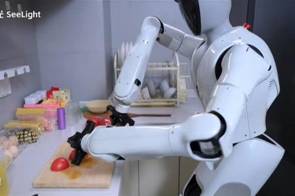 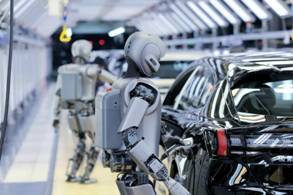
China leads the global
robotics market due to a combination of immense state-backed investment,
a complete domestic manufacturing supply chain, and high demand driven
by industrial upgrading and rising labor costs. The country controls key
component manufacturing [e.g., actuators, sensors] and utilizes
widespread AI integration to accelerate rapid, large-scale industrial
deployment.
Key factors driving
China's leadership include:
-
Government Strategy and
Policy: Initiatives like the "863 Program" and
"AI plus" treat robotics as essential infrastructure, facilitating
coordinated, large-scale efforts that link AI research with
manufacturing.
-
Unmatched Supply Chain &
Scale: China manufactures a vast portion of
global robotics components, holding roughly 70% of the market in
lidar sensors and producing crucial harmonic drivers. This allows
for faster, cheaper production compared to international
competitors.
-
Rapid Adoption and High
Demand: Facing a shrinking workforce and
rising wages, Chinese companies are rapidly adopting industrial,
collaborative, and humanoid robots, particularly in automotive and
electronics sectors.
-
Rapid Innovation & AI
Integration: China's massive AI ecosystem
(over 5,100 AI companies) facilitates rapid, data-driven
advancements in robot intelligence. Domestic companies like UBTech
and Unitree are leading in humanoid robot development and mass
delivery.
-
Economic Factors:
As labor costs rise, the decreasing cost of robotics makes
automation essential for maintaining efficiency and competitive
advantage.
-
Government Factors:
Most importantly, the Chinese government’s ability to develop and
execute long term visions on time and within budget.
Consequently, China now
uses more industrial robots than the US, Japan, South Korea, and Germany
combined.
Robotics will also play
a crucial, increasingly significant role in alleviating China's aging
population problems with the market for elderly-care robots expected to
reach 50 billion yuan by 2025. Key applications include AI-powered
companions, health monitoring [heart rate/breathing], rehabilitation
exoskeletons, and automated service robots in care homes that address
severe caregiver shortages.
Key Application Areas &
Technology
-
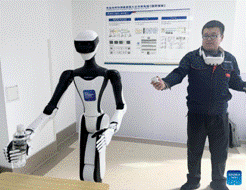
Companion and Service Robots:
Robots such as "Yang Yang" provide emotional support, wake-up calls,
and entertainment for seniors living alone.
-
Health Monitoring & Safety:
AI robots in facilities monitor vital signs, remind residents to
take medication, and notify staff of emergencies.
-
Rehabilitation & Mobility:
Exoskeleton devices are being deployed to help stroke survivors and
those with limited mobility walk again.
-
Daily Living Assistance:
Specialized robots assist with tasks like showering, lifting, and
navigating, reducing the burden on human care workers.
-
Technological Advancements:
The industry is moving toward integrating AI large models with IoT
technologies for improved interaction, including understanding
various Chinese dialects.
Challenges and
Future Outlook
While the potential is high, widespread adoption faces obstacles,
including high costs - some advanced robots exceed 100,000 yuan - and
technical limitations in handling complex, specialized care needs.
Government initiatives are pushing for more affordable, specialized, and
accessible, or "intelligent," robotic solutions to bridge the gap in
both urban and rural elderly care services
FUTURE DIRECTIONS AND
DEVELOPMENT FOR CHINA ROBOTICS INDUSTRY
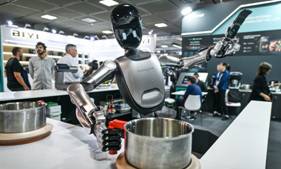 
China is rapidly
transitioning from the world's largest consumer of industrial robots to
a global leader in robotics innovation, driven by a national strategy to
counter an aging workforce, boost manufacturing productivity, and
achieve technological self-reliance
Future developments are
heavily focused on Embodied AI [EAI]—integrating artificial
intelligence into physical robots to enable learning and adaptation—and
the mass production of affordable humanoid robots.
The following are some
key future directions and developments in China's robotics sector based
on 2025–2026 data:
1. The Rise of "Embodied
AI" and Humanoids
-
Mass Production
Goal: China aims to achieve mass
production of humanoid robots by 2025 and establish a secure,
reliable industrial supply chain for them by 2027.
-
Market
Dominance: In 2025, Chinese firms were
estimated to produce over 90% of the world's humanoid robots.
Companies like
Unitree Robotics,
AgiBot, and UBTECH are leading, with units often priced at a
fraction of Western counterparts [e.g., ~$6,000 for basic models].
-
"Brain"
Development: The focus is shifting
from pre-programmed movement to AI-powered adaptability, allowing
robots to learn from human workers and navigate complex
environments.
2. Strategic Industrial
Application ["Robot+"]
-
Beyond
Manufacturing: The "Robot+"
Application Action Plan promotes robot adoption in diverse sectors,
including agriculture, logistics, healthcare, and education.
-
"Dark
Factories": There is an increase in
fully automated "dark factories" where only robots work,
particularly in automotive and electronics, where China installed
295,000+ new industrial robots in 2024, more than the rest of the
world combined.
-
Industrial
Upgrading: Robots are being deployed
to handle hazardous or high-precision tasks, with a specific focus
on sectors facing labor shortages.
3. Key Technological
Trends
-
Sensor Fusion
and Control: Future developments
emphasize advanced sensor fusion (vision-language-action models) to
enable robots to handle unstructured environments, move from "blind"
to "intelligent" operation.
-
Domestic Core
Components: To counter import
restrictions, China is heavily investing in the local production of
core components like high-precision servomotors, reducers, and AI
chips.
-
Open-Source
Ecosystems: Companies like Huawei are
open-sourcing AI toolkits to foster a domestic ecosystem and
establish international standards for robotic AI.
4. Government and Economic
Policy Support
-
Massive
Investment: A new, state-backed fund
(part of the 15th Five-Year Plan preparations) intends to invest up
to 1 trillion yuan (~USD 138 billion) over 20 years into AI and
robotics start-ups.
-
Local Government
Support: Regional governments
(Beijing, Shanghai, Shenzhen) are providing subsidies, such as
covering 20% of the cost for companies purchasing locally
manufactured robots.
-
"Unveiling the
List": The government uses the
“unveiling the list and appointing the leader” mechanism to fund
specific, high-stakes research challenges.
5. Future Challenges and
International Position
-
Competition &
"Involution": The domestic industry is
entering a "trench warfare" phase of intense competition
(involution), with thousands of companies fighting for market share,
which is expected to result in high-quality, low-cost winners.
-
Geopolitical
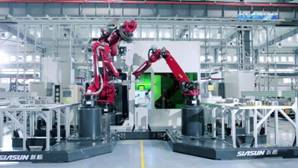
Friction: As Chinese robots, such as
those from Siasun or Estun, become more competitive globally, they
are expected to face increasing trade barriers, particularly in the
US and Europe.
-
Technical Gaps:
While strong in application, China still faces challenges in
high-end, fundamental component research compared to leading foreign
firms, though this gap is closing rapidly
MAJOR ROBOTICS PLAYERS IN CHINA
 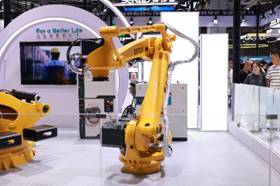
China has established
itself as the world's largest market for industrial robots for over a
decade, with domestic firms now accounting for over 50% of sales
The industry is rapidly
advancing, with a significant push into humanoid robots, driven by
companies like Unitree and Agibot.
Here are the major
players in the Chinese robotics sector as of 2025-2026:
Top Industrial Robot
Manufacturers Domestic Leaders]
-
ESTUN Automation
[9.5% market share in 2024]: The
largest domestic industrial robot manufacturer in China, offering a
comprehensive range from 3kg to 1000kg, serving industries from
automotive to welding.
-
INOVANCE
Technology [8.8% market share in 2024]:
The fastest-growing company, leveraging expertise in servo systems
and motion control, with strong, competitive SCARA and six-axis
robots.
-
SIASUN Robot &
Automation [6.2% market share]: A
pioneer with strong ties to the Chinese Academy of Sciences [CAS],
specializing in industrial robots, mobile robots [AMRs], and smart
manufacturing.
-
EFORT
Intelligent Equipment [5.4% market share]:
Known for strong international, with 44% of revenue from exports in
2024, focusing on welding and automotive solutions.
Top Humanoid & Embodied AI
Startups
-
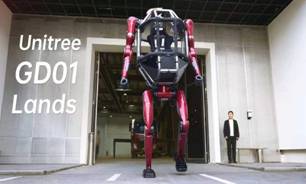
Unitree Robotics:
Considered the market leader, known for agile robots like the G1 and
H1. Unitree shipped 5,500 units in 2025, making it the top seller.
-
Agibot (Shanghai
AgiBot Innovation Technology): A major
competitor focusing on "embodied intelligence" with products like
the Expedition A3. It shipped 5,168 units in 2025.
-
UBTECH Robotics:
Known for the Walker S2 industrial humanoid, it is a key player in
bringing humanoid robots to automotive factory lines.
-
Engine AI:
Notable for high-mobility robots [T800] capable of complex
manipulation, demonstrated at major events.
-
Deep Robotics:
Specializes in industrial-grade quadruped robots and is part of the
"six little dragons" leading Chinese robotics.
-
Galbot & Noetix:
Emerging leaders in the humanoid space, featured in major national
showcases in 2026.
Key Components & Supply
Chain
-
Leaderdrive:
A top global producer of harmonic reducers, crucial for robot
joints.
-
Fine Motion
Technology: A key manufacturer of
rotating-vector reducers, increasing its market share significantly
in 2024.
-
Eyou Robot
Technology: Opened the first automated
production line for humanoid robot joints.
Emerging Trends
-
"Six Little
Dragons": Refers to a group of leading
startups, including Unitree, Deep Robotics, BrainCo, Manycore Tech,
Game Science, and DeepSeek.
-
EV Synergy:
Many robot companies are leveraging supply chains from the electric
vehicle [EV] sector, focusing on high-torque motors, inverters, and
lidar.
-
"Robot Policy"
Integration: Chinese companies are
heavily supported by government "Robotics+" initiatives, often
appearing in high-profile events like the Lunar New Year Gala
|
