|
CHINA INTERNET OF THINGS
The Internet of Things
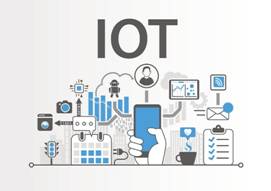
[IoT] is a network of physical "things" embedded with sensors, software,
and technologies that connect and exchange data with other devices and
systems over the internet. It enables everyday objects—from home
appliances to industrial tools—to communicate, act autonomously, and be
monitored remotely to improve efficiency and automation.
Key Aspects of IoT:
-
Components:
Devices use sensors to collect data and connect via Wi-Fi,
Bluetooth, or cellular networks.
-
Functionality:
They share data with the cloud or
directly with other devices to run commands
-
Examples:
Smart home devices such as thermostats and cameras, wearables such
as fitness and health trackers, industrial sensors such as imaging
and infrared, and connected cars.
-
Benefits:
Increased productivity, improved efficiency, and enhanced
data-driven insights.
Main Categories of
IoT:
-
Consumer IoT:
Personal devices like smart watches, voice assistants, and home
automation.
-
Commercial/Industrial/Military IoT :
Used in sectors like manufacturing for inventory tracking,
predictive maintenance, and infrastructure management
IoT connects physical
devices to the internet, allowing them to collect, exchange data, and
act autonomously. It is primarily used for remote monitoring,
predictive maintenance, automation of daily tasks, and data-driven
decision-making across industries like manufacturing, healthcare,
agriculture, and smart home management.
KEY
APPLICATIONS OF IOT:
AGRICULTURE
IoT (Internet of
Things) is revolutionizing agriculture by enabling precision farming,
which allows for real-time monitoring and automation of farming
processes to increase efficiency, reduce waste, and maximize yields. By
connecting sensors, drones, and machinery to the internet, farmers can
shift from experience-based decision-making to data-driven, automated
operations.
Here is some examples
of how IoT is used in agriculture:
1.
Smart Irrigation and Water Management
IoT sensors monitor
soil moisture, temperature, and humidity, transmitting data to automated
systems that deliver precise amounts of water to the root zone.
-
Benefits:
Reduces water wastage by up to 6% or more, prevents over-irrigation,
and optimizes plant health.
-
Applications:
Automatic water pumps (e.g., in loamy/sandy soil) that turn off when
moisture levels are sufficient.
2. Precision Crop Management
and Monitoring
IoT-enabled sensors
(monitoring nutrient status, pH levels, CO2) and field cameras track
crop growth in real-time.
-
Fertilizer and
Nutrient Application: Soil sensors
analyze nutrient content (NPK) to determine the exact amount of
fertilizer needed, reducing chemical runoff.
-
Pest and Disease
Detection: Cameras and sensor data
allow for early identification of pests and diseases, enabling
targeted, minimal pesticide use.
3. Livestock Monitoring
Wearable IoT devices
attached to livestock track health, location, and behavior.
-
Health Tracking:
Sensors monitor vital signs, body temperature, heart rate, and
activity levels to detect illness or reproductive cycles early.
-
Geofencing:
Protects animals from theft or straying by creating virtual
boundaries.
4. Drones and Autonomous
Machinery
Unmanned Aerial
Vehicles (UAVs) and drones provide aerial imagery to monitor large
fields, assessing landscape, crop health, and soil conditions.
-
Automated Tasks:
Robotic seeders and sprayers, guided by GPS and IoT, perform tasks
without direct human supervision, reducing labor costs.
5. Smart Greenhouses
IoT technologies
automate the environment within greenhouses, controlling temperature,
water, light, and humidity without manual intervention.
6. Supply Chain and Logistics
Management
IoT devices are used to
track the location and condition of agricultural products from the farm
to the consumer.
7. Environmental Monitoring
IoT weather stations
provide real-time updates on environmental parameters, allowing farmers
to prepare for, or respond to, severe weather events (e.g., frost
protection).
Key Challenges and
Considerations
-
High Upfront
Costs: Implementing IoT solutions can
be expensive, particularly for small-scale farmers.
-
Data Security
Risks: Connected systems are
susceptible to cyberattacks, data theft, and sabotage.
-
Connectivity
Issues: Rural areas often lack
reliable internet, which is necessary for constant data
transmission.
-
Lack of
Technical Expertise: Proper
installation and management of IoT devices require technical
knowledge that some farmers may lack.
Despite these
challenges, the integration of IoT, AI, and Big Data is considered a key
factor for future-proofing food production
INDUSTRY
AND MANUFACTURING
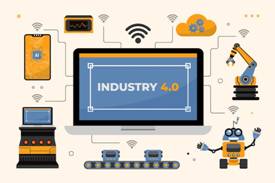 
IoT (Internet of
Things), specifically Industrial IoT (IIoT), revolutionizes
manufacturing by
connecting sensors and
devices to monitor, analyze, and optimize production in real-time. Key
applications include predictive maintenance to reduce downtime,
automated quality control, supply chain tracking, and
enhanced worker safety. These technologies increase efficiency,
reduce costs, and enable smarter, sustainable, and data-driven
factories.
Key Applications of IoT in
Industries and Manufacturing:
-
Predictive Maintenance:
Sensors monitor machine health (vibration, temperature, sound) to
detect potential failures before they occur, reducing downtime and
maintenance costs.
-
Production Efficiency and
Automation: Real-time data monitoring allows
manufacturers to optimize production lines, identify bottlenecks,
and automate processes for higher output.
-
Quality Control and Assurance:
IoT sensors in manufacturing lines monitor for deviations in product
quality (e.g., in food or electronics), ensuring consistency and
reducing waste.
-
Supply Chain and Asset
Tracking: Real-time tracking of raw materials
and finished goods ensures better inventory management, visibility,
and faster delivery times.
-
Improved Safety and
Compliance: Wearable devices and environmental
sensors monitor for hazardous conditions (e.g., gas leaks, high
temperatures) and employee safety, reducing workplace accidents.
-
Remote Monitoring:
Managers can monitor and control factory operations from remote
locations, allowing for faster response to issues.
-
Energy Management:
IoT helps in monitoring energy usage across machines and systems,
enabling reduced consumption and more sustainable manufacturing
practices.
Key Enabling Technologies:
-
5G Connectivity:
Provides low-latency networks for real-time control.
-
Edge AI:
Processes data directly on devices for instant analysis.
-
Digital Twins:
Virtual replicas of physical systems used for simulations.
MILITARY
IOT
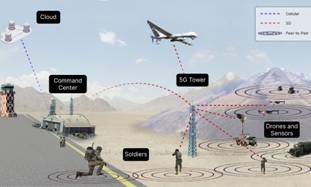 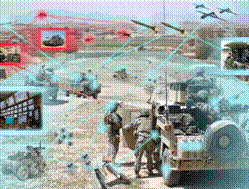
IoT (Internet of
Things) in military and warfare, often called the Internet of
Battlefield Things, enhances operational efficiency through
interconnected sensors, drones, and wearable devices. Key applications
include real-time battlefield intelligence, autonomous surveillance,
predictive maintenance of equipment, enhanced soldier health monitoring,
and smart, secure base operations
Key Applications of IoT in
Military and Warfare:
-
Enhanced
Situational Awareness: Sensors,
drones (UAVs), and vehicles collect and share data in real-time,
feeding it into command centers to improve decision-making. These
sensors can be deployed on the ground, in the air, or even as "smart
dust" (e.g., e-plants) to monitor enemy movement.
-
Autonomous
Systems and Robotics: Unmanned Aerial
Vehicles (UAVs), Unmanned Ground Vehicles (UGVs), and sensors are
used for reconnaissance and surveillance, reducing risk to human
soldiers.
-
Wearable
Technology for Soldiers: Smart
devices monitor soldier health, track vitals, detect injuries, and
improve performance on the battlefield.
-
Logistics and
Supply Chain Management: IoT optimizes
supply chains by tracking ammunition states, fuel, and equipment in
real-time, allowing for automated, efficient logistical support.
-
Smart Bases and
Security: IoT sensors provide
perimeter security, using biometric data for access control to
protect against unauthorized entry.
-
Predictive
Maintenance: Sensors on vehicles and
machinery can predict failures before they happen, ensuring
equipment is always combat-ready.
-
Data-Driven
Decision Making: Data aggregated from
diverse sources is analysed to provide a comprehensive view of the
operational theatre, enabling faster, more precise responses
Key Challenges and
Considerations:
-
Security and
Vulnerability: Increased connectivity
raises the risk of cyberattacks, requiring strong encryption and
security protocols.
-
Data Overload:
The immense volume of data collected must be processed, analysed,
and prioritized to be useful for decision-makers.
-
Interoperability: Ensuring that
different devices, systems, and branches can work together is
crucial for a unified, effective network.
CIVILIAN
IoT
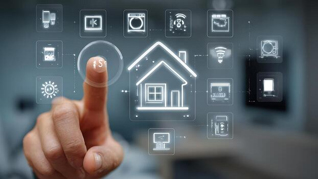 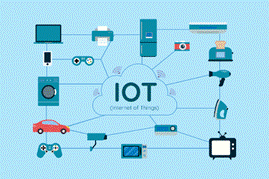
The Internet of Things
(IoT) is heavily integrated into daily life, transforming routine tasks
through connected devices that collect, share, and act on data to
increase convenience, safety, and efficiency
IoT devices in daily
life range from smart home appliances and wearables to connected
vehicles and environmental monitoring systems.
Here is how IoT is used
in daily life, categorized by application:
1. Smart Home Automation
(Convenience and Efficiency)
IoT devices allow for
remote management and automation of home environments, improving comfort
and energy savings.
-
Smart
Thermostats: Devices like Nest learn
heating/cooling preferences and automatically adjust, or allow
remote control via smartphone.
-
Lighting and
Appliances: Smart bulbs and plugs can
be scheduled or voice-controlled, while smart refrigerators and
washing machines can be monitored remotely.
-
Voice
Assistants: Amazon Alexa, Google Home,
and Apple HomeKit act as central hubs to manage multiple smart
devices through voice commands.
-
Smart Security:
Video doorbells (e.g., Ring), smart locks, and cameras provide
real-time surveillance and access control from anywhere.
2. Personal Health and
Wearables
Wearable technology
tracks physical activities and vital signs, enabling proactive health
management.
-
Fitness
Trackers: Devices like Fitbits or
Apple Watches monitor heart rate, sleep patterns, and activity
levels, often sharing this data with healthcare providers.
-
Health Monitors:
Specialized sensors can measure blood pressure or assist with elder
care, such as smart diapers or medication reminders.
3. Transportation and Mobility
Connected vehicles use
IoT for improved safety and performance.
-
Connected Cars:
Modern vehicles from manufacturers like Tesla or BMW use IoT for
navigation, remote diagnostics, and entertainment.
-
Advanced Driver
Assistance: Systems detect lane
drifting, monitor speed, and help prevent collisions.
-
Logistics &
Navigation: Real-time traffic data,
smart parking, and vehicle tracking improve commute efficiency.
4. Smart Cities and
Infrastructure
IoT contributes to
cleaner, safer urban environments through efficient management of
resources.
-
Traffic
Management: Sensors monitor traffic in
real-time, allowing for adaptive traffic lights that reduce
congestion.
-
Environmental
Monitoring: Sensors detect air
quality, noise levels, and manage smart streetlights that adjust
brightness based on activity.
-
Waste
Management: Smart bins can track fill
levels, optimizing trash collection routes to prevent overflowing.
5. Daily Services and Retail
-
Smart Retail:
Beacons in stores provide personalized shopping experiences and help
retailers manage inventory.
-
Smart
Agriculture: Small-scale, IoT-enabled
irrigation systems can adjust watering based on weather and soil
conditions.
Key Benefits and
Risks in Daily Life
-
Benefits:
Increased convenience, enhanced security, improved energy
efficiency, and better health monitoring.
-
Risks:
Privacy concerns regarding data collection, security vulnerabilities
that allow hackers to spy or gain access to networks [e.g., botnets],
and over-reliance on technology.
CURRENT
STATUS OF IoT TECHNOLOGY IN CHINA
China is currently the
world's largest market for the Internet of Things (IoT), driven by
massive government investment in digital infrastructure and a strong,
state-backed manufacturing sector.
As of 2024, China
Mobile, China Telecom, and China Unicom managed roughly 74% of all
global cellular IoT connections. The market is rapidly evolving from
simple connectivity to advanced, AI-enabled industrial applications and
5G-enabled smart city projects.
Key Aspects of the Current IoT
Status in China:
-
Market
Leadership: China is both the primary
producer and consumer of IoT goods. The Chinese IoT market is
projected to reach $412 billion by 2025, with cellular connections
surpassing 1.8 billion by the end of 2022.
-
Dominant
Players: The market is highly
concentrated, with China Mobile leading globally in cellular
IoT connections and revenue. Other top players include Huawei,
Alibaba, Tencent, Quectel, and Fibocom.
-
5G and
Infrastructure: By the end of June
2025, China installed over 4.55 million 5G base stations,
underpinning high-speed, low-latency IoT applications. The country
is heavily investing in "East Data West Computing" to enhance
computing power for industrial AI applications.
-
Key Sectors:
The largest IoT industries in 2023 were discrete manufacturing ($18
billion), hybrid manufacturing ($9 billion), and automotive ($6
billion).
-
Strategic
Initiatives: The market is driven by
"Made in China 2025" and "Internet Plus" initiatives, aiming to
modernize manufacturing and urban management [e.g., Alibaba's "City
Brain"].
Emerging Trends and Challenges
[2025–2026]:
-
5G-A and Passive
IoT: China is launching 5G-Advanced
[5G-A] projects, including passive IoT, which enables tracking and
sensing without active power sources.
-
Rise of 5G
RedCap and LTE Cat-1 bis: These
technologies are increasingly used to replace older 2G/3G networks,
providing more efficient alternatives for asset tracking, smart
meters, and industrial use cases.
-
Geopolitical
Scrutiny: Increased US-China tensions
are causing challenges. The US has placed restrictions on key
Chinese IoT vendors like Quectel, prompting some reassessment by
Western device manufacturers, though Chinese firms remain dominant.
-
Standardization
Issues: Despite being a leader in 5G,
China is still working to align its domestic IoT standards with
global standards, as many Chinese-developed platforms are not fully
compatible with international systems.
Major Hubs:
-
Wuxi:
Considered China's "IoT Capital," with over 3,000 companies focusing
on Industrial IoT and vehicle-to-everything [IoV] ecosystems.
-
Ningbo:
Developing as a major center for intelligent manufacturing and
digital twins.
WHY CHINA
LEADS THE WORLD
China’s leading
position in the Internet of Things (IoT) and its widespread applications
is driven by a combination of aggressive state-led industrial policies,
massive infrastructure investment, and a massive consumer market. As of
2024–2025, China is projected to have the highest number of IoT
connections worldwide, aiming for over 10 billion by 2026.
1. State-Led Industrial
Policies [Top-Down Approach]
The Chinese government
has designated IoT as a strategic "pillar" industry for national
development, fostering an environment where growth is supported by
high-level planning and subsidies.
-
"Made in China
2025": This initiative prioritizes
intelligent manufacturing, upgrading traditional industries with AI
and IoT to transform China into a "manufacturing superpower".
-
"Internet Plus"
Plan: A directive focused on
integrating the internet with traditional industries (manufacturing,
medicine, finance) to create new economic engines.
-
14th Five-Year
Plan (2021-2025): The strategy focuses
heavily on digitalizing infrastructure, with a 2026-2030 outlook
heavily prioritizing R&D, innovation, and technological security.
2. Unrivalled Infrastructure
Development
China’s rapid
deployment of 5G and other connectivity networks provides the "backbone"
necessary for massive IoT deployment.
-
5G Leadership:
By 2025, China is expected to have the most 5G base stations,
offering the high-speed, low-latency connectivity required for
advanced IoT applications like autonomous vehicles and industrial
robots.
-
5G + Industrial
Internet: China has launched over
1,500 "5G plus Industrial Internet" projects, promoting automation
and real-time data monitoring in factories.
-
Satellite
Technology: China is investing heavily
in a dedicated satellite constellation to support IoT services,
ensuring connectivity for remote applications.
3. Massive Scale and Supply
Chain Dominance
China is both the
largest manufacturer and the largest consumer of IoT devices.
-
"Smart City"
Dominance: With over 500 smart city
pilot projects, China is a pioneer in deploying narrowband-IoT (NB-IoT)
for traffic, energy, and security systems.
-
Integrated
Supply Chain: Chinese firms control a
significant portion of the IoT supply chain, including sensors,
chips, and components, allowing for faster production and lower
costs.
-
Cellular IoT
Leadership: As of late 2024, Chinese
operators (China Mobile, China Telecom) commanded over 70% of the
world's cellular IoT connections.
4. Key Players and Application
Scenarios
Major Chinese tech
giants are driving adoption across diverse sectors, including smart
homes, smart vehicles, and industrial, automation.
-
Huawei & ZTE:
Leading in 5G infrastructure and providing comprehensive IoT
platforms.
-
Xiaomi & Alibaba:
Major drivers of consumer IoT, smart home devices, and industrial
cloud computing.
-
Intelligent
Connected Vehicles (ICVs): Companies
like Baidu (Apollo) are building extensive partnerships for
autonomous and connected driving.
5. Favorable Consumer and
Regulatory Environment
-
High Adoption
Rate: Consumers in China are generally
more accepting of connected devices, which drives rapid uptake of
smart home appliances and wearables.
-
Integrated Data
Ecosystems: The use of IoT for "social
stability" and surveillance, within a "safe city" framework,
encourages the deployment of sensors and surveillance
infrastructure.
MOST IMPORTANT:
-
Government Leadership: Most important
factor for China’s success is the government’s ability to develop and
execute long term visions successfully on time and on budget.
Government policies and expenditures are focussed on benefiting the
country and its people rather than special interests.
-
Massive Scientific and Engineering Talent.
China produces more STEM students each year than the
US and G7 countries combined. Most of the world’s top STEM
universities and research institutions are in China
Key Data Points
(2024-2025)
-
Total IoT
Connections: Expected to reach over 10
billion by 2026.
-
Market Growth:
The Chinese IoT market is expected to grow by roughly 22-26%
annually.
-
Industrial
Focus: The largest applications are
discrete manufacturing ($18B+ in 2023) and automotive.
Despite these
strengths, China faces challenges, including US-led "decoupling" in
high-performance semiconductors and rising security concerns regarding
data privacy.
FUTURE
DIRECTIONS AND DEVELOPMENT OF IOT IN CHINA
The future of the
Internet of Things (IoT) in China is characterized by a state-led
transition from basic connectivity to a "fully connected" intelligent
society, with a strong focus on Industrial IoT (IIoT), artificial
intelligence integration (AIoT), and smart city development. Driven by
the 15th Five-Year Plan (2026-2030), China is prioritizing innovation
and technological self-reliance in the IoT sector to bolster economic
growth, enhance manufacturing efficiency, and address societal needs
like aging populations.
Here are the key future
directions and developments in China’s IoT landscape:
1. Strategic Focus and Policy
-
15th Five-Year
Plan (2026-2030): The upcoming
blueprint places immense emphasis on R&D, digital infrastructure,
and economic security, accelerating the shift from "Made in China"
to "Intelligent Manufacturing".
-
AIoT
Convergence: IoT is evolving into AIoT
(Artificial Intelligence of Things), where AI acts as the "brain"
for the "body" of connected devices, allowing for real-time data
processing and autonomous decision-making in cities and factories.
-
"Zhuan Jing Te
Xin": The government is promoting
specialized, high-growth, niche SMEs to drive innovation in specific
IoT components and applications.
2. Major Industrial and
Technological Developments
-
Industrial
Internet of Things (IIoT): This is a
primary focus for enhancing productivity. By 2030, manufacturing and
public services are expected to account for over 60% of IoT's GDP
impact in China.
-
5G/6G and Edge
Computing: Widespread 5G deployment is
providing the backbone for massive IoT connectivity. Future
developments include integrating 6G, next-generation photonic
devices, and edge computing to reduce latency for real-time
applications like autonomous driving.
-
Digital Twins:
The adoption of digital twin technology for the simulation and
optimization of physical assets—especially in manufacturing and
smart city management—will become mainstream.
-
Intelligent
Connected Vehicles (ICVs): With strong
support, over half of new vehicles sold in China are expected to
incorporate autonomous features by 2025, with massive investment in
vehicle-to-everything (V2X) technology.
3. Key Application Areas
-
Smart Cities and
Urbanization: China has over 500 smart
city initiatives, with future focus on integrating AI, IoT, and big
data to manage public safety, traffic congestion, and energy,
particularly in mega-cities like Shenzhen.
-
Smart Healthcare
and Eldercare: Driven by an aging
population, IoT solutions for remote monitoring and AI-assisted
healthcare are rapidly growing, aiming to improve accessibility and
efficiency.
-
Environmental
Monitoring and Green IoT: IoT is being
deployed for smart grids, disaster prevention, and monitoring to
support China's peak carbon emissions goal by 2030.
4. Technical Challenges and
Future Trends
-
Standardization:
While China leads in connections, achieving a unified IoT standard
across diverse platforms remains a challenge. The 15th Five-Year
Plan will likely push for harmonizing domestic standards with
international ones, particularly through initiatives like the "Belt
and Road".
-
Security and
Privacy: As the number of connected
devices rises, there is an increased focus on blockchain-based
security, data encryption, and authentication to combat
vulnerabilities.
-
Energy-Harvesting Devices: Development
is moving toward more energy-efficient and, in some cases,
energy-harvesting IoT devices to reduce maintenance costs.
5. International Impact and
Competition
-
Shaping Global
Standards: Chinese firms (e.g., Huawei,
Alibaba) are increasingly influencing international standards (ISO/IEC)
for IoT, making them major players in global digital infrastructure.
-
Technological
Self-Reliance: Facing "decoupling"
pressures, China is doubling down on developing domestic
alternatives for high-performance semiconductors and core IoT
technologies.
The market for
connected IoT devices in China is projected to reach USD 140.2 billion
by 2032, driven by these high-tech, state-supported initiatives.
MAJOR IoT
PLAYERS IN CHINA
Major players in
China's IoT market as of 2026 include tech giants
Huawei, Alibaba Cloud,
and Xiaomi, alongside major telecom operators like China Mobile, which
drive infrastructure and AIoT ecosystems. Key module and hardware
providers dominating the market include Quectel, Fibocom, and Sunsea
Group.
Key IoT Players in China (2026)
-
Infrastructure &
Cloud:
Huawei (networks/platforms), Alibaba Cloud
(cloud),
China Mobile
(5G IoT).
-
IoT Modules &
Hardware:
Quectel,
Fibocom, Sunsea Group, MeiG Smart, and Neoway.
-
Consumer/Smart
Home IoT:
Xiaomi,
Tuya Smart,
Midea,
Aqara, and EZVIZ.
-
Industrial/Specialized IoT: CATL
(energy/battery IoT), Gosuncn.
These companies are
heavily invested in 5G, edge computing, and AIoT to drive industrial
automation and smart city infrastructure. |
