|
CHINA BIG DATA TECHNOLOGY
Big data refers to
massive, complex, and rapidly growing data sets that exceed the capacity
of traditional data processing software, such as spreadsheets, to manage
or analyze. It encompasses structured, semi-structured, and unstructured
data (like videos or social media posts) requiring advanced technologies
to derive insights, improve decision-making, and automate processes.
Key Characteristics
of Big Data
-
Volume:
The sheer amount of data generated, often in terabytes or petabytes,
from sources like social media, sensors, and transactions.
-
Velocity:
The speed at which data is generated, collected, and processed,
often in real-time.
-
Variety:
The different types of data, including structured (databases),
semi-structured (XML), and unstructured (images, videos).
-
Veracity:
The accuracy, quality, and trustworthiness of the data.
-
Value:
The ability to turn data into meaningful insights or actionable
business intelligence.
Examples and Sources of
Big Data
-
Social Media:
Posts, likes, and images on platforms like Facebook and Twitter.
-
IoT/Sensors:
Data from smart devices, industrial machines, and GPS trackers.
-
Transactions:
Banking records, retail loyalty card purchases, and credit card
usage.
Key Application Areas and Use Cases
·
Energy and Utilities:
Smart meters and sensors analyze consumption patterns to balance loads
and improve grid efficiency.
-
Healthcare:
Analyzing patient data for predictive diagnostics, precision
medicine, and improved treatment outcomes.
-
Transportation/Logistics:
Using real-time data to optimize routes, manage fuel consumption,
and monitor fleet performance.
-
Retail/Marketing:
Utilizing customer behavior data from online and offline sources to
deliver personalized recommendations and improve inventory
management.
Big Data Applications
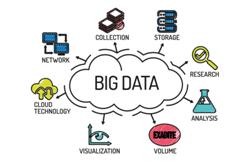
Big data is used to
analyze vast, complex datasets - characterized by high volume, velocity,
and variety - to uncover hidden patterns, market trends, and customer
preferences, allowing organizations to make informed, real-time
decisions, optimize operations, and drive innovation. It is critical for
predictive analytics, personalized marketing, risk management, and
enhancing efficiency across diverse industries.
Applying big data in
industries involves collecting structured/unstructured data via IoT
sensors, MES, and CRM systems, storing it in data lakes (HDFS), and
using machine learning for predictive/prescriptive analytics to enhance
operational efficiency, reduce downtime, and improve decision-making.
Key uses of big data include:
-
Customer
Insights and Personalization:
Companies analyze purchasing behavior, social media trends, and user
data to deliver personalized recommendations (e.g., Netflix, Amazon)
and improve user experiences.
-
Predictive
Maintenance in Manufacturing:
Sensors collect data from machines to predict equipment failures
before they occur, reducing downtime and maintenance costs.
-
Fraud
Detection and Security:
Banks and financial institutions use big data analytics to identify
anomalous transaction patterns in real-time, significantly improving
fraud detection.
-
Healthcare
Improvement: Data from
electronic health records, wearable devices, and research is used to
identify disease trends, improve diagnostics, and tailor treatment
plans.
-
Operational
Efficiency and Logistics:
Transportation companies and retailers use data to optimize delivery
routes, manage supply chains, and maintain inventory levels.
-
Smart Cities
and Public Services:
Government agencies use data for traffic management, urban planning,
and emergency response, such as using sensors to reduce traffic
congestion.
-
Targeted
Advertising: Advertisers
leverage consumer behavior data to target specific demographics more
effectively, increasing conversion rates.
Big data is often
called "the new oil" because it transforms raw data into actionable
insights that drive business growth and competitive advantage.
Status of Big Data in China
China leads the world
in big data technology and development due to a massive, digitised
population of over 1.4 billion, providing unmatched data volume needed
for training AI. A centralized government strategy prioritizes data as
a core national asset, driving heavy investment in infrastructure, such
as massive data centers and 5G networks. This is supported by a large
pool of STEM talent, rapid consumer adoption of digital services, and a
robust ecosystem of tech giants integrating data across finance and
social platforms.
Key Factors for China's Global
Leadership Include:
-
Vast Data Generation:
With a population of 1.4 billion people and over 1.1 billion
internet and e-commerce users, the high volume of daily digital
transactions, social media activity, and surveillance footage feeds
rapid data refinement and training of AI models.
-
Government-Driven Support and
Infrastructure:
The state treats data as a critical production and socio-economic
efficiency driver, investing over trillion dollars in R&D and
infrastructure, building extensive and massive data centers across
China.
Furthermore, big data giants such as Alibaba and Tencent is looking
to increase annual spending on data centers to over $28 billion.
This includes innovative "undersea data centers" to meet
high-power, high-density AI needs.
-
Integrated Digital Ecosystems:
Apps such as
WeChat integrate social, financial, and daily services, allowing for
superior data collection compared to more fragmented Western
systems.
-
Centralized Data Access &
Regulatory Environment:
China’s regulatory approach allows for more centralized data
accumulation compared to the West, which aids in training large AI
models and accelerating machine learning applications.
-
Aggressive Application:
Chinese companies are fast to market with AI-based products,
utilizing data to refine products quickly.
-
Talent Pool and R&D:
China produces approximately 5 million STEM graduates annually and
holds a majority share of the world's top AI researchers and
patents. Seven of the top 10 STEM universities are in China.
The country has 47% of
the world’s top AI researchers and more than 60% of AI patents. It
continues investing heavily in the workforce and encourage students
to study Big Data and AI.
In the next five years, China aims to achieve full independence from
foreign countries in its Big Data AI development. Affected by U.S.
export restrictions, the nation is prioritizing more efficient and
less expensive AI technologies.
-
Aggressive Application:
Chinese companies are fast to market with AI-based products,
utilizing data to refine products quickly.
-
Energy supply:
Data centers are energy intensive. China has more nuclear power
plants under construction than the rest of the world combined, which
will become critical to meeting the power demands of data centers.
Unlike many western countries such as the US, China’s electricity
generation, transmission and storage systems super modern. This is
one of key reasons why the G7 countries is incapable to compete
successfully with China.
-
Massive Data Market:
The big data industry is booming, with over 190,000
data-related enterprises and an industry value exceeding $277
billion USD with a 20%+ annual growth rate. The growth of China's
data industry is actively supporting the R&D of domestic AI large
models
-
Cost Reduction:
Identifying inefficiencies and optimizing resource allocation.
-
Increased Revenue:
Uncovering new market opportunities and improving product
development.
-
Enhanced Decision-Making:
Using data-backed insights to guide strategic decisions.
Future Big Data Development, Directions
and Trends in China
-
"AI Plus" Initiative Integration:
The next phase emphasizes "AI Plus," a strategic shift to deepen AI
integration across industries, utilizing data to move from simple
internet applications to advanced, intelligent manufacturing,
healthcare, and city management.
-
Data as a Factor of Production:
China has officially elevated "data" to a key factor of production
alongside land, labor, and capital, aiming for a market-oriented,
high-quality, and standardized data circulation system.
-
Industrial and Vertical
Applications:
Moving beyond Internet-based applications (e.g., e-commerce), the
focus is on "industrial big data," such as building specialized,
massive, and high-quality datasets in manufacturing, new materials,
and healthcare to train domestic large models.
-
Infrastructure Expansion:
Continued investment in "digital infrastructure" is underway, with
5G base stations reaching nearly 3.92 million by mid-2024,
facilitating real-time analytics and edge computing.
-
Data Security and Governance:
A "local storage, outbound assessment" regime is being enforced to
balance data innovation with national security, with policies
focusing on data classification, security, and privacy protection
Major Big Data Players in China

-
Alibaba Group:
Dominates cloud computing and e-commerce, utilizing massive
transaction data for consumer insights and logistics. Global market
share more than 40%.
-
Tencent
Holdings: Controls huge
social data through WeChat/QQ, with a strong focus on fintech and
gaming analytics.
-
Baidu, Inc.:
Leads in search, AI, and autonomous driving data, controlling a high
percentage of the Chinese search market.
-
Huawei
Technologies: A crucial
infrastructure provider, focusing on cloud data centers, IoT, and 5G
data management.
-
ByteDance:
Known for Douyin (TikTok) and Toutiao, using algorithms for
massive-scale content recommendations and data analysis.
-
JD.com:
Major e-commerce player with significant data in logistics, supply
chain, and retail.
-
Telecom
Operators (China Telecom, China Mobile, China Unicom):
Control vast, foundational data on network usage, mobile activity,
and infrastructure.
-
Specialized
AI/Data Firms: SenseTime
and iFlytek are recognized as part of China's "national AI teams"
for computer vision and speech recognition.
-
Emerging
Startups: Companies like
Wanyigui Technology, Sealevel Technology, and Ninetech are gaining
prominence with high-speed data trend scores.
|
